
ByJohn A
Does a Cold Plunge Add Value to Your Home?
A cold plunge tub rarely moves an appraisal by a fixed dollar amount, but in markets where wellness amenities are in demand, real estate agents report it can shorten time on market and support a modest premium, often in the same range as a hot tub, roughly 1 to 3 percent of home value in a strong comparable market. The bigger factor is placement and plumbing: a permanently installed unit with proper drainage and electrical work reads as a real amenity, while a garage-corner tub reads as clutter a buyer has to remove.
What Actually Drives the Value of a Cold Plunge
Appraisers work off comparable sales, and cold plunges are still too new in most markets to show up as a standard line item the way a pool or a second garage does. What they do respond to is functional, permanent installation. A plunge tub plumbed into a dedicated drain, wired on its own circuit, and set into a finished patio or bathroom area reads differently than a portable tub sitting on a deck. The first looks like part of the house. The second looks like equipment a new owner will have to decide whether to keep.
Local demand matters more than the amenity itself. In cities with a strong fitness or recovery culture, agents increasingly list cold plunges alongside saunas and home gyms as lifestyle features that get buyers into open houses. In more conservative markets, the same feature can sit neutral or even work against a sale if a buyer sees it as one more thing to maintain.
How Much Does It Cost to Install One Well
A quality standalone tub with a built-in chiller and filtration runs $4,000 to $9,000 for the unit itself. Add $500 to $1,500 for a 20-amp dedicated circuit and GFCI protection, and another $500 to $1,000 if you want a proper drain line instead of manual draining. Outdoor installations need a level pad, usually a simple concrete or paver base, which runs a few hundred dollars more. All in, a well-installed setup lands between $5,000 and $12,000, considerably less than a pool but enough that it should be treated as a real capital improvement, not a weekend purchase.
Where Placement Makes or Breaks the Investment
The tubs that hold value best sit somewhere a future owner could repurpose easily: a covered patio corner, a mudroom with floor drainage, or a finished basement bathroom. Tubs wedged into a garage bay or crammed against a fence line tend to get pulled out before a listing goes live, because they block normal use of the space. If you are building new or renovating, running electrical and drainage rough-in during that work is far cheaper than retrofitting later, and it signals to a future buyer that the feature was planned rather than bolted on.
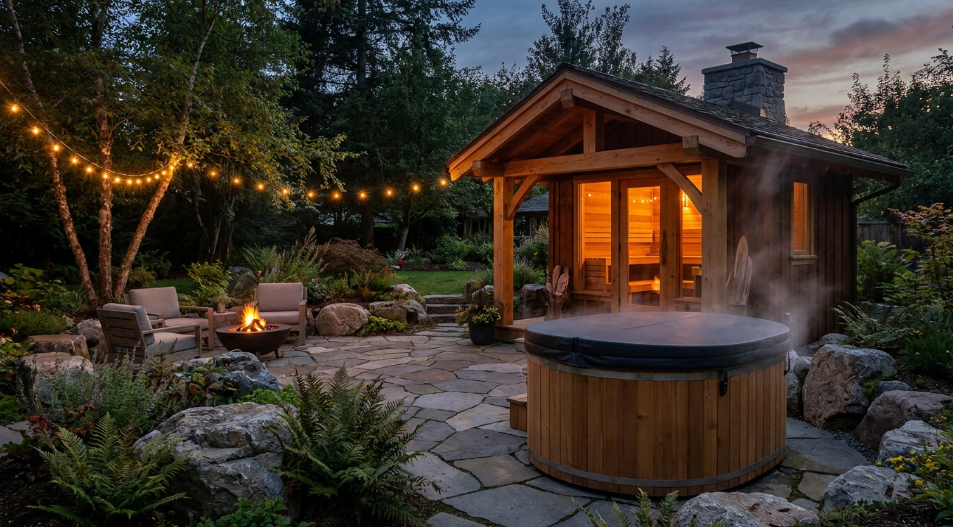
Pairing a cold plunge with an existing or planned home sauna is common, and it changes how the space reads. A hot-cold contrast setup, sauna and plunge within a few steps of each other, presents as a cohesive wellness room rather than two unrelated purchases. Homeowners shopping for saunas often check current inventory and pricing from specialty retailers such as SweatDecks alongside regional dealers and big-box options before deciding on a combined layout, since sizing the two together up front avoids a second round of electrical work.
Does the Health Case Support the Investment
Buyers researching wellness amenities often ask about the health case, and it is worth separating what is well established from what is still uncertain. The strongest data comes from the sauna side of contrast therapy. Large Finnish cohort studies have found regular sauna bathing associated with lower cardiovascular and all-cause mortality risk, and a Mayo Clinic Proceedings review summarizing that evidence base describes consistent associations across multiple cohorts, while noting the data is observational rather than a randomized trial proving causation. A separate systematic review of regular dry sauna bathing reported similar patterns of association with cardiovascular markers.
Cold-water immersion research is a different story. It is genuinely mixed. Some trials show reduced perceived muscle soreness after intense exercise, while others suggest frequent cold exposure right after resistance training can blunt strength and muscle-building adaptations if used too often. None of that means a home cold plunge has no value, but it does mean the evidence supports moderate, occasional use for recovery rather than a guaranteed performance edge.
What Should a Seller Do Before Listing a Home With a Cold Plunge
If you are selling rather than buying, treat the plunge tub like any other mechanical feature: disclose the age of the chiller, note the last filter or water change, and leave the manual or a printed maintenance sheet for the next owner. Agents say the biggest mistake sellers make is leaving a tub in visibly poor condition, cloudy water, a rusted frame, a chiller that no longer holds temperature, since a neglected amenity reads as a liability rather than a feature and can prompt a buyer to ask for a credit to remove it entirely. A tub that is clean, running, and clearly maintained costs little to show well and removes the biggest objection a buyer might otherwise have.
It also helps to separate the tub from anything that reads as a safety concern during a showing. A locking cover or a simple gate around an outdoor unit, especially one near a walkway, signals that the feature was installed thoughtfully rather than added as an afterthought. None of this changes the appraisal math directly, but it removes friction at exactly the point where a buyer is deciding whether the amenity is worth keeping.
Frequently Asked Questions
Does a cold plunge increase home resale value the way a pool does?
Not in the same way. Most appraisers treat it as a niche wellness amenity rather than a standard comparable feature, so it seldom adds a fixed dollar figure to an appraisal. In markets with strong wellness demand, agents do report it as a differentiator that helps a listing stand out.
How much does a home cold plunge cost to install?
A standalone chiller-equipped tub typically runs $4,000 to $9,000 for the unit, plus $500 to $2,500 for electrical work, a pad, and drainage depending on indoor or outdoor placement.
Do cold plunges require ongoing maintenance costs?
Yes. Budget $15 to $40 a month in electricity for the chiller, along with filtration and sanitizer supplies, plus periodic manual water changes on units without full filtration.
Is a cold plunge worth it if I already have a home sauna?
Many owners pair the two for contrast therapy. The sauna half of that routine has real, consistent evidence behind it. The cold plunge half is helpful for some recovery goals but the science is still mixed, so it is worth trying before treating it as essential.
Where should a cold plunge go to protect resale appeal?
A covered patio, mudroom, or finished basement near a drain and dedicated circuit works best. Space that a future buyer could easily repurpose if they are not interested in cold therapy protects the investment either way.
References
- Laukkanen, T. et al. “Cardiovascular and Other Health Benefits of Sauna Bathing: A Review of the Evidence.” Mayo Clinic Proceedings, 2018. https://pubmed.ncbi.nlm.nih.gov/30077204/
- “Benefits and risks of sauna bathing.” The American Journal of Medicine, 2001. https://pubmed.ncbi.nlm.nih.gov/11165553/
- “Effects of heat and cold on health, with special reference to Finnish sauna bathing.” American Journal of Physiology – Regulatory, Integrative and Comparative Physiology, 2018. https://pubmed.ncbi.nlm.nih.gov/29351426/
